We’re at the end of the month, so it’s time for a look at the best Free WordPress Themes that have been released. Here is our choice of the best free themes for June 2018. The Best Free Themes of June 2018 Blossom Coach As we all know, mental health and success are the two most important ... Read moreThe Best Free WordPress Themes June 2018
Do you want to add specific posts to your WordPress navigation menu? Menus in WordPress can be fully customized, and you can add custom links, pages, posts, categories and more. In this article, we will show you how to easily add specific posts to WordPress navigation menu.
When and Why Add Specific Posts to Navigation Menu?
Navigation menus allow you to create a navigational structure for your website. This helps users quickly find the most important sections of your website.
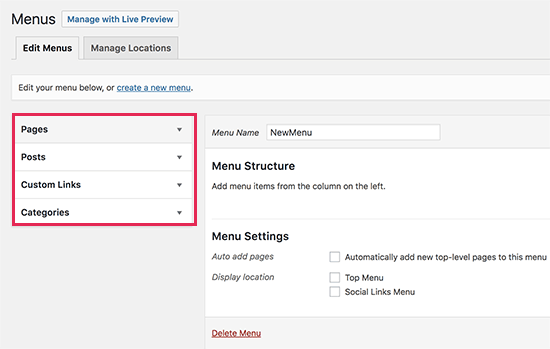
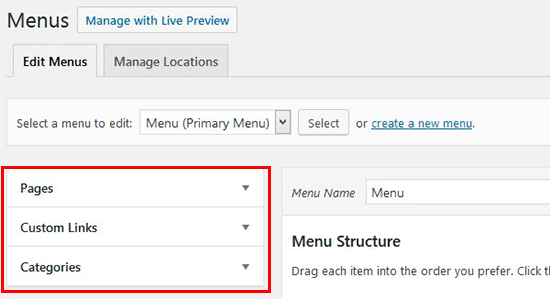
WordPress makes it very easy to create and add navigation menus on your website. By default, it shows sections to easily add pages, categories, custom links, and more.
Normally website owners add pages to their navigation menus like about page, a separate blog page, pricing page, or a contact form page.
However, sometimes you may need to add an individual post to your navigation menu. This could be your most popular post or something that you would like your users to find quickly.
That being said, let’s take a look at how to easily add specific posts to WordPress navigation menu.
Adding Specific Posts to WordPress Navigation Menu
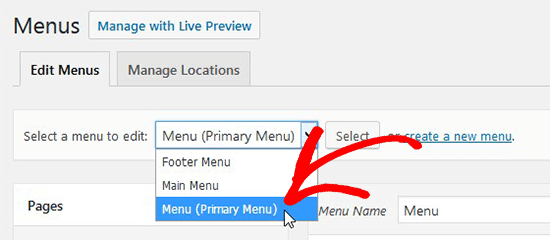
First thing you need to do is go to Appearance » Menus page in your WordPress admin area and select a menu to edit. You can also create a new menu and use it as your navigation menu.
After selecting the menu, you’ll see tabs for pages, posts, custom links, and categories. You can click on each tab to expand it.
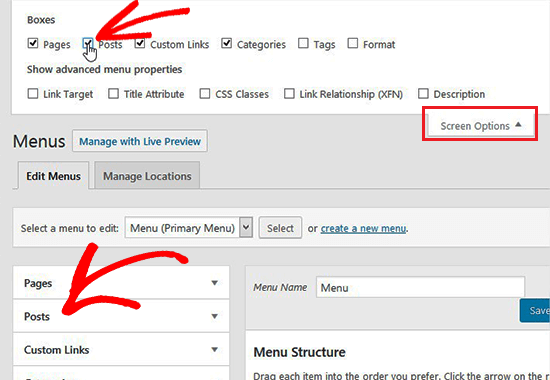
If you cannot see the Posts tab there, then you need to add it by clicking on the Screen Options button at the top right corner of the screen.
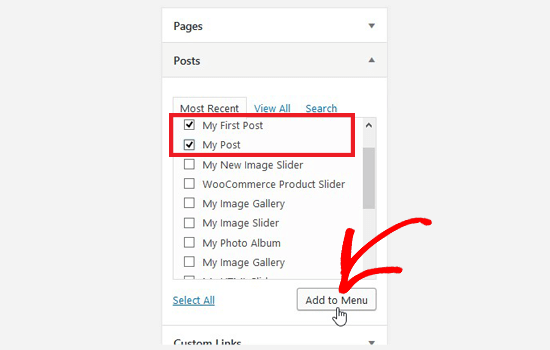
Once the Post box appears, you need to expand it to select the specific posts that you want to add to your navigation menu and click on the Add to Menu button.
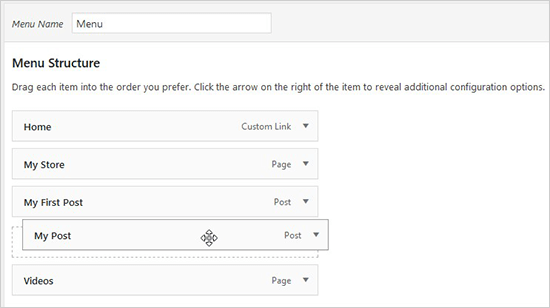
After adding the specific posts to the navigation menu, you can drag and drop menu items to adjust their display order.
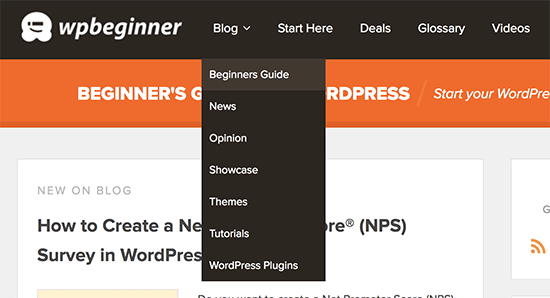
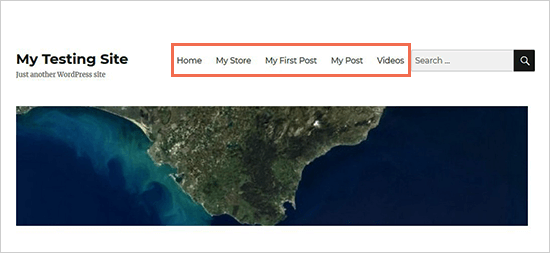
You can also customize the label to change the post title into a smaller title. Make sure to save it and visit your website to see your WordPress navigation menu with specific posts in action.
We hope this article helped you learn how to add specific posts to WordPress navigation menu. You may also want to see our expert pick of the best tutorials to master WordPress navigation menus to easily customize and manage your blog navigation.
If you liked this article, then please subscribe to our YouTube Channel for WordPress video tutorials. You can also find us on Twitter and Facebook.
You know WordPress is awesome – but you want to be better at it. So how do you get better? The same way you get better at anything – you get some WordPress training. And with the huge variety of WordPress training videos and courses, it’s never been easier to up your WordPress skills – ... Read moreWordPress Training: Where To Find Courses And Videos To Up Your Skills
Do you want to create a professional business email address for free? A business email address uses your company name and looks a lot more professional than a generic gmail or hotmail account. In this article, we will show you how to easily create a free business email address in just 5 mins with step by step instructions.
What is a Business Email Address?
Unlike a generic email, a professional business email address allows you to use your own company name as your email address such as: [email protected].
Most beginners use their personal email accounts for business. These email addresses are often created using email service providers like Gmail or Yahoo, and they don’t look very professional.
A business email address looks more professional and is easy to remember for customers. If you want your customers and other businesses to take you seriously, then you need to start using a professional business email address.
What Do You Need to Create a Business Email Address?
You will need to have domain name and a website to create a free business email address. After that, you will need an email service to handle your mail.
There are few different solutions that you can use to create a professional business email address. We will show you two different methodsm and you can choose the one that best fits your needs.
Method 1. Creating a Business Email Address for Free
This method is easy and available to almost everyone who has a website. It allows you to create a business email address for free.
When creating a small business website, you will need to signup for a domain and web hosting.
What most beginners don’t know is that many WordPress hosting companies offer free business email features as part of the package.
Normally, a domain name costs 14.99 per year and website hosting starts from $7.99 per month. You can add another $5 per email account if you were using a paid email service too.
Luckily, Bluehost, one of the largest WordPress hosting company in the world, has agreed to offer WPBeginner users a free domain name and 60% off discount on hosting.
This means you can start a business website for $2.75 per month (and it comes with a free business email address).
Here is the complete step by step instructions to create your first free business email address.
Step 1. Set up your Business Address (Domain Name)
First, you need to visit the Bluehost website and click on the green ‘Get Started Now’ button.
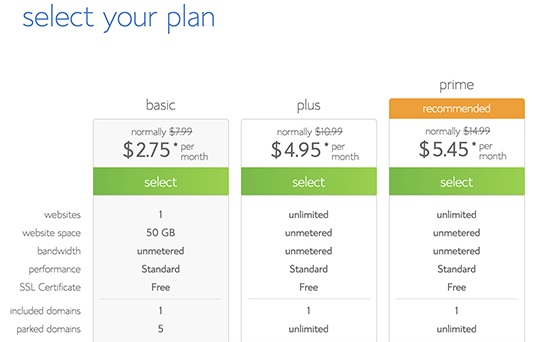
This will bring you to a pricing page where you need to click on the ‘Select’ button below the plan you want to use. Basic and Plus plans are popular among small businesses who are just getting started.
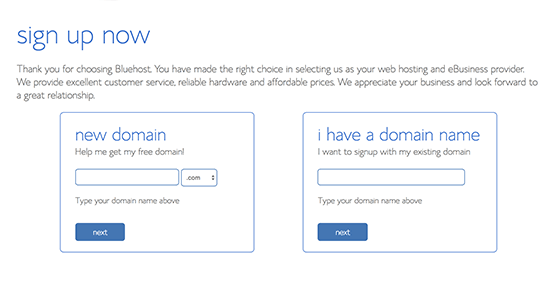
After selecting your plan, you will be asked to choose your domain name. You need to enter your business name and click on the ‘Next’ button.
Bluehost will now check to see if a domain name matching your business name is available. If it is not, then it will show you some suggestions, or you can look for another domain name.
Here are some quick tips on choosing the perfect domain name for your business email address.
Always choose a .com domain name. See our article on the difference between .com vs .net domain names to learn more.
Keep your domain name short, easy to remember and pronounce.
Do not use numbers or hyphens in your domain name
Try using keywords and business location in your domain name to make it unique. For example, if stargardening.com is not available, then look for stargardeninghouston.com
Choosing a good domain name is crucial for your business but don’t spend too much time on that or you will never get past this step.
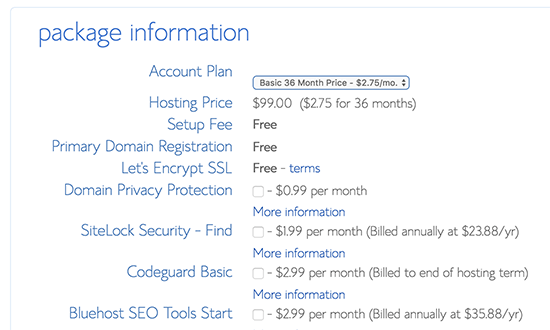
After choosing your domain name, you will need to add your account information and finalize the package info to complete the process.
On this screen, you will see optional extras that you can purchase. We don’t recommend choosing them at this time. If you need them, then you can always add them later from your account.
Lastly, you need to enter your payment information to finish the purchase.
You will receive an email with details on how to login to your web hosting control panel. This is where you manage everything from emails, support, website management, among other things.
Step 2. Creating Your Free Business Email Address
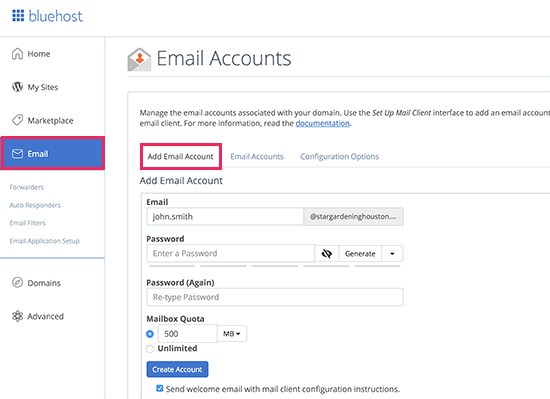
In your hosting account dashboard, you need to click on the ‘Email’ section and then click on ‘Add Email Account’ tab.
Enter a username and password for your email account and then click on the ‘Create Account’ button.
Bluehost will now create the email account for you and you will see a success message.
Step 3. Using Your Business Email Account
Now that you have created your free business email account, the next step is to learn how to use it to send and receive emails.
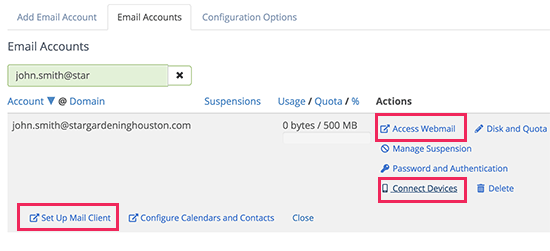
Under the ‘Email’ section on your hosting account, switch to the ‘Email Accounts’ tab. You will see your newly created email address listed there.
You can click on the ‘Access webmail’ link and Bluehost will take you to a webmail interface. This is a good option if you don’t want to use an email client.
However, you will have to log in to your hosting account each time you want to check your email. A better way is to click on connect devices and then click on set up mail client link.
Bluehost will show you the information needed to use your business email address with any mail client or app. You can use this information to set up using Outlook, Gmail, or any Mail app for your mobile phone or desktop.
Note: the process of creating a business email is similar for other hosting companies that offer cPanel like SiteGround, HostGator, and InMotion Hosting.
Method 2. Creating a Business Email Address using Gsuite
Google offers professional business email address with Gsuite which includes Gmail, Docs, Drive, and Calendar for businesses.
This method is not free, but it allows you to use Gmail for your professional business email with your own business name. While there’s a small cost, it comes with many advantages.
You will be using Gmail’s familiar interface and apps to send and receive emails.
Google has far superior technology which ensures that your emails are delivered right away and they don’t end up in spam folders.
Your website hosting company has shared server resources. This means they don’t want you to send too many emails. Gmail on the other hand, will allow you to send up to 2000 emails per day.
That being said, let’s take a look at how to set up a business email address using Gsuite.
Step 1. Sign up for a Gsuite Account
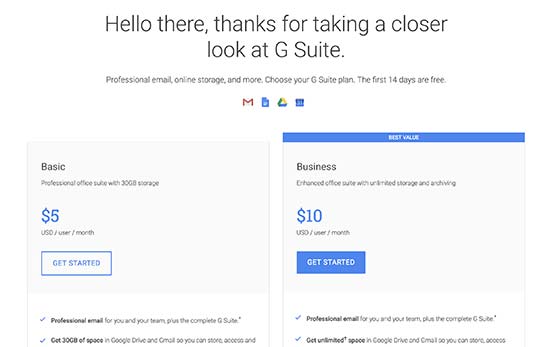
Gsuite basic plan costs $5 per user each month. It gives you access to Gmail, Docs, Drive, Calendar, and audio/video conferencing with 30 GB of cloud storage for each user.
You will also need a domain name, which you can purchase during the signup. If you already have a domain name and a website, then you can use your existing domain with Gsuite.
To get started, simply visit the Gsuite website and click on the get started button.
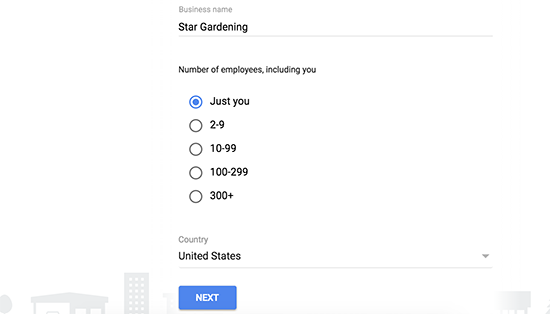
On the next screen, you will be asked to enter your business name, the number of employees, and country where you are located. You can choose just yourself for 1 user account, or choose the number of employees.
Note: You will be charged for each user account, so it is better to start small. You can always add more user accounts when needed.
Click on the next button to continue.
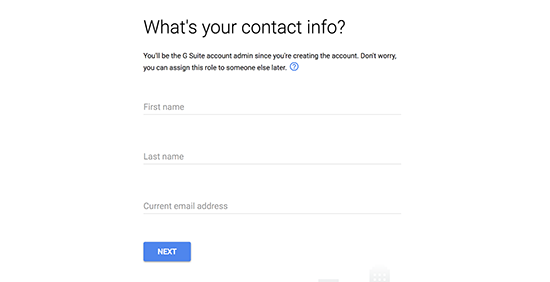
You will be asked to enter your personal contact information including name and email address.
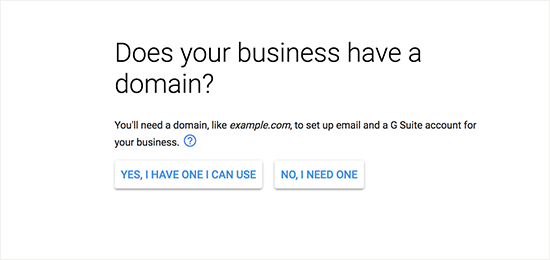
On the next screen, you will be asked to choose a domain name. If you already have a domain name, then click on ‘Yes I have one I can use’ or click on ‘No, I need one’ to register a domain name.
If you need to register a new domain name, then you will be charged separately for registering a new domain name. The cost of a domain name will be displayed on the screen and usually starts from $14.99 per month.
If you are using an existing domain name, then you will need to verify that you own that domain name. We will show you how to do that later in this article.
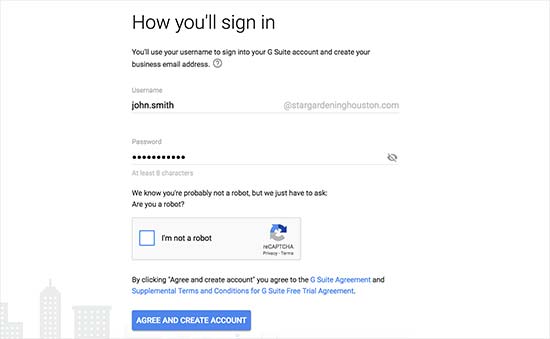
After choosing your domain name, you will be asked to create your user account by entering a username and password.
This username will also be your first business email address, so you need to choose a username that you want to use as your business email address.
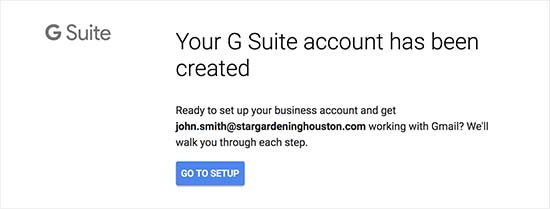
After that, you will see a success message and a button to continue with the setup.
Step 2. Setting up Gsuite and Email
In this step, you will complete the Gsuite set up by setting up users and connecting it to your website or domain name.
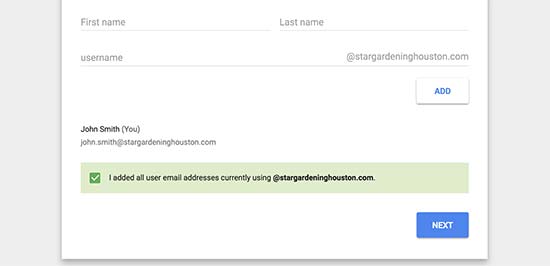
On the setup screen, you will be asked to add more people to your account. If you wanted to create more accounts for your employees or departments, then you can do that here.
You can also just click on ‘I have added all user email addresses’ and click on the next button. You can always add more users to your account and create more email addresses later when needed.
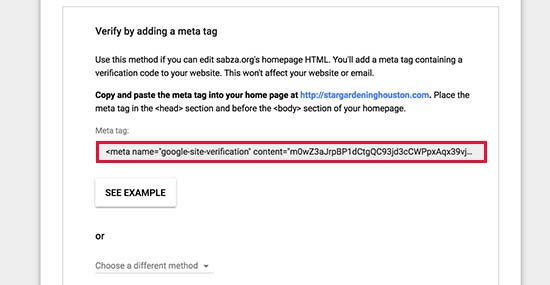
If you are using Gsuite with an existing domain name, then you will be asked to verify that you own that domain name. To do that, you will now see a HTML code snippet that you need to add to your website.
There are other ways to verify your ownership as well. You can upload a HTML file to your website using an FTP client or file manager app in your hosting account dashboard.
If you don’t have a website, then you can use the MX Record method to verify your ownership of the domain name. You will see step by step instructions to do that once you choose this method.
For the sake of this article, we are assuming that you already have a WordPress website, and we will show you how to add the verification HTML code snippet in WordPress.
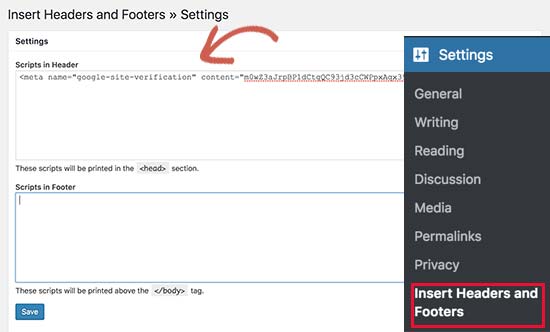
Upon activation, go to Settings » Insert Headers and Footer page and paste the HTML code you copied from Gsuite under the ‘Scripts in Header’ section.
Don’t forget to click on the ‘Save’ button to store your settings.
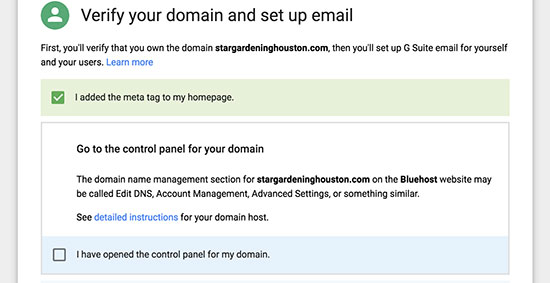
Now switch back to your Gsuite setup screen and click on the checkbox that says ‘I added the meta tag to my homepage’.
After that, you will be asked to enter MX record entries for your domain name. We will show you how to do that in the next step.
Step 3. Adding Domain MX Records
Note: This section is for users with existing domain names and websites. If you registered a new domain name via Google, then you don’t need to read this.
Domain names tell the internet servers where to look for information. Since your domain name is not registered with Google, your emails will reach your domain name but not to Google servers.
You will need to setup the right MX records on your domain name settings. This will tell your domain name server to use Google’s servers for sending and receiving emails.
To do that, log in to your web hosting account, or your domain registrar account. We will show you how to add MX records in Bluehost, the basic settings are the same on all hosts and domain registrars. Basically, you will be looking for DNS settings under your domain name.
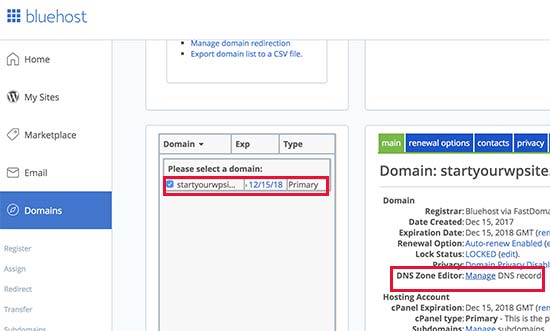
Login to your Bluehost hosting dashboard and click on ‘Domains’. On the next page, select your domain name and then click on the ‘Manage’ link next to DNS Zone Editor option.
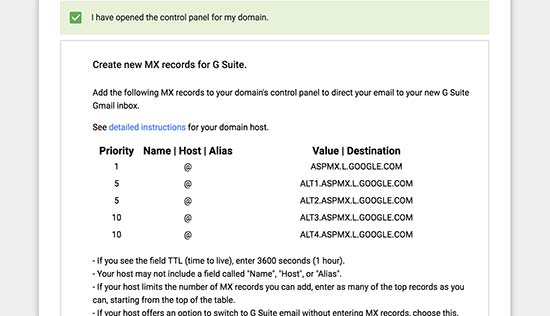
Bluehost will now open your DNS zone editor. You need to switch back to your Gsuite setup screen and check the box that says ‘I have opened the control panel of my domain name’.
It will now show you the MX records that you need to enter. You will also see a link to the documentation which will show how to add these records to dozens of hosting and domain services provider.
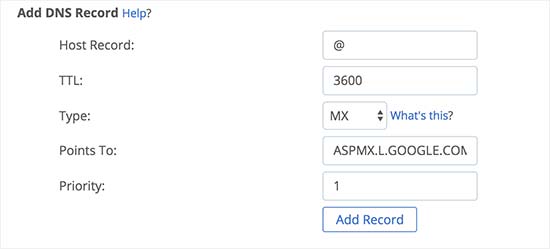
Here is how you will add this information to your Bluehost DNS settings
Click on ‘Add Record’ button to save it. After that, repeat the process to add all five lines as MX records.
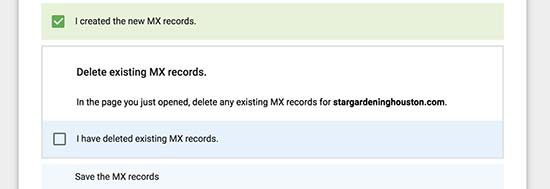
Once you are finished, switch back to Gsuite setup and check the box next to ‘I created the new MX records’.
You will be asked to delete any existing MX records still pointing to your website hosting or domain name provider servers.
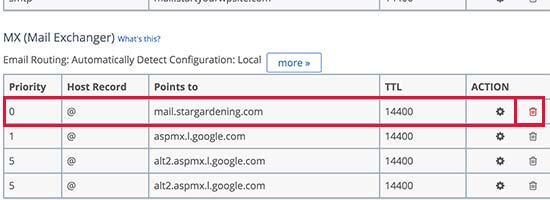
Switch back to your DNS zone editor and scroll down to MX records section. You will see the MX records you created earlier along with an older MX record still pointing to your website.
Click on the delete button next to the old MX record to delete it.
After that, switch back to the Gsuite setup screen and check the box that says ‘I deleted existing MX records’.
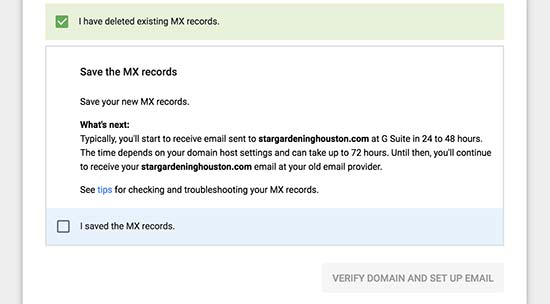
You will now be asked to save your MX records. For some providers once you add MX records they are already saved, for some you may need to manually save MX records.
Once you have saved MX records check the box that says ‘I have saved MX records’ in Gsuite setup.
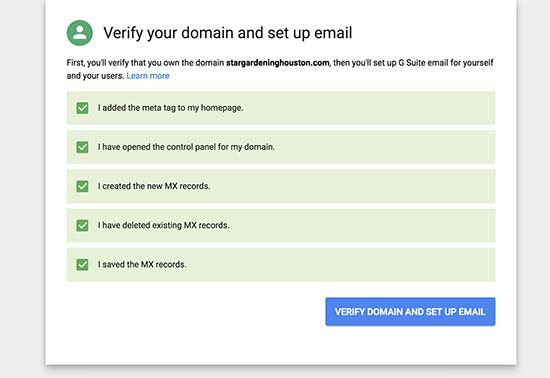
After that you need to click on ‘Verify domain and setup email’ button to exit the setup wizard.
Step 4. Managing email in Gsuite
Gsuite makes it super easy to manage your email account. You can simply visit the Gmail website to check your email or use the official Gmail apps on your phone to send and receive emails.
You will need to sign in using your business email address as your username.
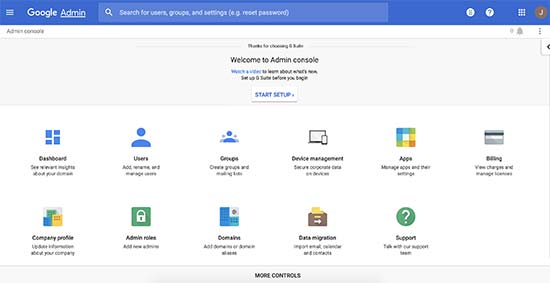
To create more business email addresses simply go to the Gsuite Admin console. From here you can add new users, make payments, and adjust your Gsuite account settings.
That’s all, we hope this article helped learn how to create a free business email address or create a professional business address with Gsuite. You may also want to see our guide on how to fix WordPress not sending emails issue.
If you liked this article, then please subscribe to our YouTube Channel for WordPress video tutorials. You can also find us on Twitter and Facebook.
In this Jupiter v6 WordPress theme review, we’ll be taking a look at the newest version of this impressive multipurpose theme. Whether you are a blogger, business, marketer, or are looking for a theme for a different niche, Jupiter, with its wide range of templates, design elements, and unlimited customization options, could be the theme for ... Read moreJupiter v6 Theme Review: The Next Generation of Jupiter
ARForms WordPress form builder plugin is a popular solution for building a range of fully responsive forms: a basic WordPress contact form, a workshop registration form, surveys, a job application form, and many more plain and complex types of forms. ARForms plugin has been around successfully for more than 4 years now. During this time, ... Read moreARForms WordPress Form Builder Plugin: The Ultimate Review
Do you want to create a Net Promoter Score (NPS) survey in WordPress?
Net Promoter Score is a popular method to measure customer loyalty, so you can improve your brand image, find new product ideas, and provide better customer service.
In this article, we will show you how to easily create a Net Promoter Score® Survey in WordPress, and how to properly use it to improve your business.
What is Net Promoter Score?
Net Promoter Score is a management tool that helps businesses measure customer loyalty. The idea was first introduced in 2003, and since then more than two-thirds of Fortune 1000 companies have adopted it.
Here is how it works.
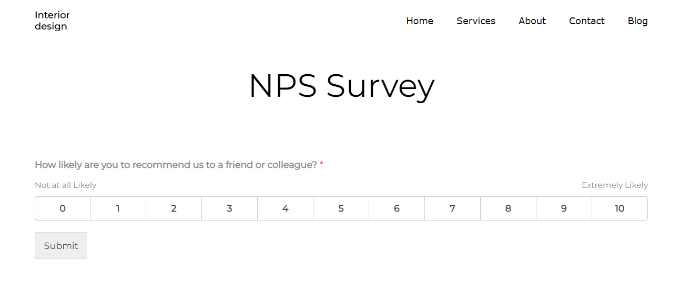
It is based on a single question, ‘How likely are you to recommend our company/product/service to a friend or colleague?’
The answer is provided on a scale of 0 to 10.
Customers who respond with a score of 9 or 10 are called ‘Promoters’. These are your brand’s most loyal customers and are highly likely to purchase again and recommend your business to others.
Users who answer with a score between 0-6 are considered ‘Detractors’. These are the customers who are unhappy with your business and are least likely to purchase or recommend your business.
Customers responding with a score of 7 or 8 are called ‘Passives’. They can be either promoters or detractors and are less likely to actively recommend your business and products to their friends or colleagues.
Your final NPS score is calculated by subtracting the percentage of detractors from the percentage of promoters. The overall score ranges from -100 to 100.
A -100 score means all customers are detractors and a full 100 score means all customers that took part in the survey were promoters. Normally, a score of positive numbers (0-40) is considered good, and a score of 50 or above is considered excellent.
Due to the popularity of NPS surveys among businesses, there are numerous very expensive survey tools that will charge you hundreds of dollars per month. These solutions are not very affordable for small businesses.
WPForms is a paid plugin, and you will need at least their Pro plan to access the surveys addon used in this tutorial.
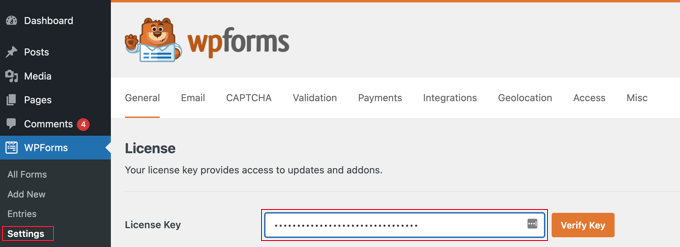
Upon activation, you need to visit WPForms » Settings page from your WordPress to enter your license key. You can find this information under your account area on the WPForms website.
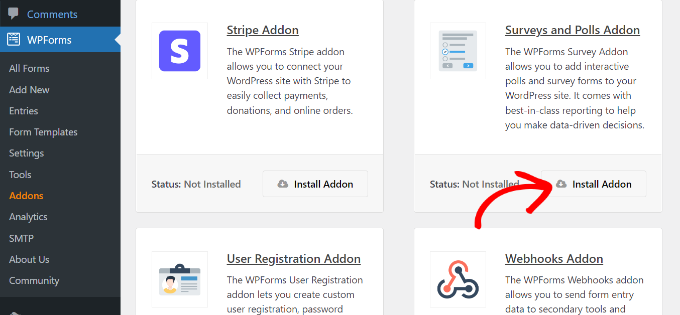
After entering your license key, you need to visit the WPForms » Addons page and locate the ‘Surveys and Polls Addon.’
Go ahead and click on the ‘Install Addon’ button. WPForms will now install and activate the addon.
You are now ready to create your first Net Promoter Score survey form.
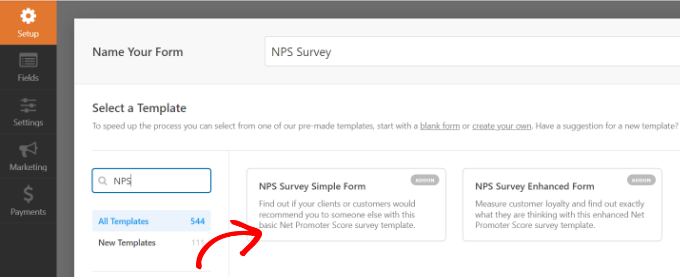
Head over to WPForms » Add New from the WordPress admin panel to create a new form. First, you need to provide a title for your form, and then select a form template.
WPForms offers lots of prebuilt form templates. You can simply search for an NPS form template from the search bar on the left.
For this tutorial, we will use the ‘NPS Survey Simple Form’ template.
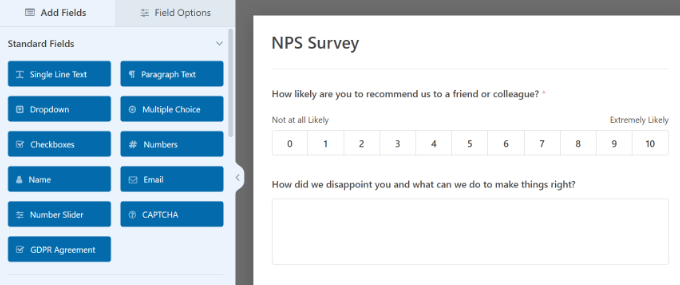
WPForms will now load the form builder interface with some typical survey form fields.
This is a drag-and-drop form builder where you can just point and click to edit any existing form fields or add new fields from the left column.
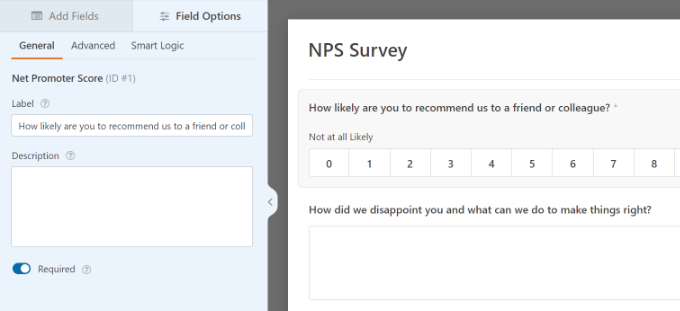
If you click on the existing fields in the form, then you’ll see more options for customization.
For instance, you can change the text for each question and make it a required field.
Your Net Promoter Score survey form is now almost ready. Simply getting the score is not very helpful because you don’t know why these customers are unhappy or happy.
Let’s add some smart conditional fields to the form to get more helpful feedback from users.
Adding Conditional Logic to Net Promoter Score Survey Form
WPForms comes with a smart conditional logic feature that allows you to show or hide form fields based on the user’s answers to previous form fields.
You can use that feature to ask users for more feedback based on their answers. For example, you can ask users who select a score between 0-6 to give you another chance to make things right. These customers are unhappy and asking them for an opportunity to make things right will help you improve your relationship with these customers.
Similarly, you can also ask users giving a score between 9-10 to leave a testimonial and ask for their permission to share it on your website. These are your most loyal customers, and their testimonials can help you add social proof to your website.
Let’s add these conditional fields to your NPS survey form.
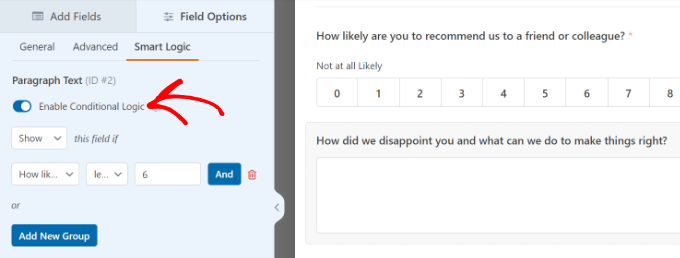
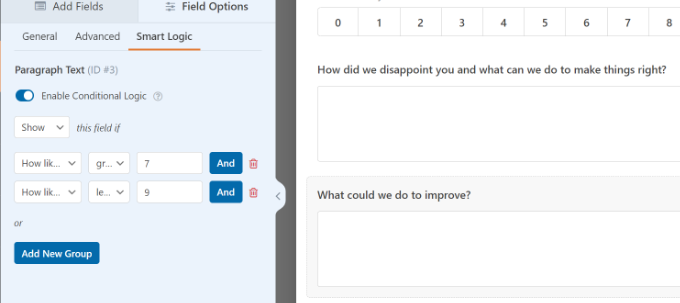
First, select the question after the NPS scale. Next, switch to the ‘Smart Logic’ tab from the menu on your left and click the ‘Enable Conditional Logic’ toggle to enable the option.
We only want to show this field to users responding with a score between 0 and 6. To do that, we will add conditional logic to this form field.
WPForms will add the logic by default. However, you can edit the rating for which you’d like to show the survey question.
Similarly, you can set up conditional logic for the second question in the survey. By default, WPForms will set the condition for you and only show the field when the score is between 7 and 9.
You can edit these conditions according to your survey needs. However, if you’re just starting out, then we recommend using the default settings.
Now repeat the process for other questions in the form. Don’t forget to save your changes.
Adding Your Net Promoter Score Survey in WordPress
WPForms makes it super easy to add forms to any post or page on your website.
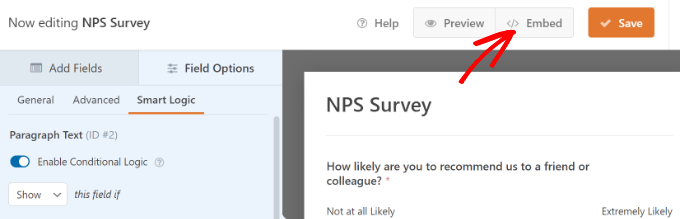
You can simply click the ‘Embed’ button inside the form builder to get started.
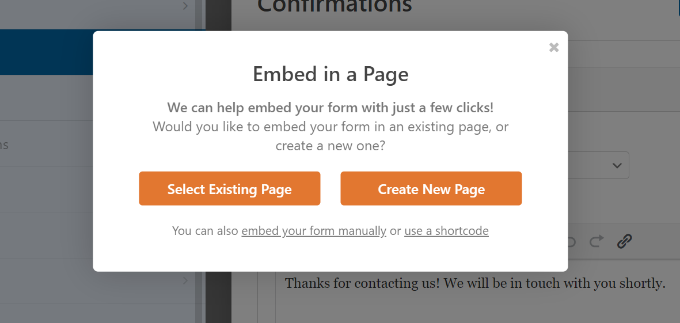
Next, you’ll see 2 options to embed the NPS survey. You can create a new page or select an existing page.
We’ll choose the ‘Create New Page’ option for this tutorial.
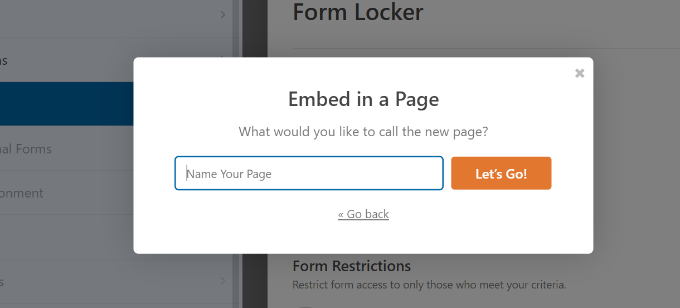
After that, a popup window will open.
Simply enter a name for your new page and click the ‘Let’s Go’ button.
Next, you should see your NPS survey form embedded in the content editor.
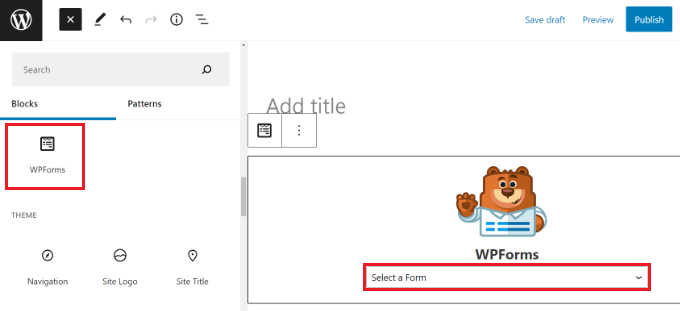
Alternatively, you can also use the WPForms block to add the NPS form anywhere on your website.
Simply click the ‘+’ button to add the WPForms block. After that, select your form from the dropdown menu.
You can now save your changes and visit your website to see the form in action.
Now, whenever a user selects a score between 0 to 6, they will see another form field asking for their feedback.
Viewing Your Net Promoter Score Results
After your form is live, WPForms will start calculating your Net Promoter Score based on survey results. You can send the NPS survey link to your customers using an email marketing service to encourage them to fill it out.
After a few users have filled out the form, you can go ahead and check your score.
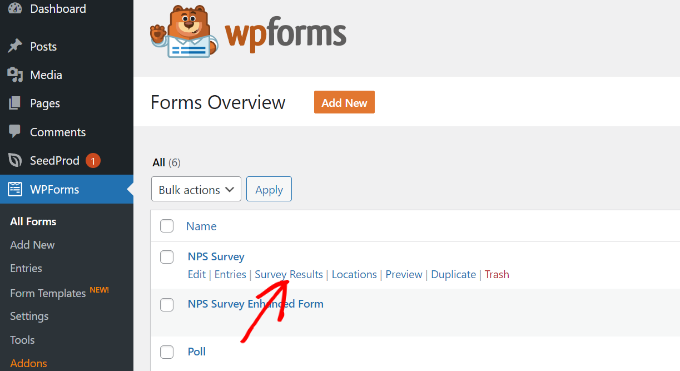
To do that, head over to WPForms » All Forms from your WordPress dashboard and click on the ‘Survey Result’ link under your Net Promoter Survey form.
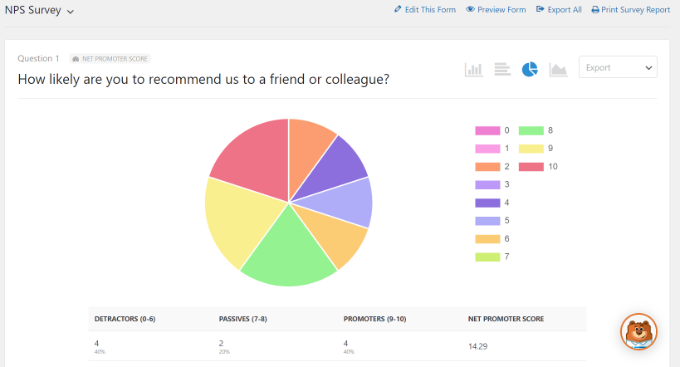
WPForms will now display your total Net Promoter Score along with the number of promoters, detractors, and passives. It will also break down the results into beautiful charts, bars, and graphs.
You can use the feedback from users to improve your product, add new features, as well as offer support to unhappy customers and turn them into loyal brand evangelists.
As part of WordCamp Europe, Matt Mullenweg laid out the roadmap for Gutenberg over the next three months. In July, there will be a prompt to push more Gutenberg usage (as a plugin). Then, we might see a WordPress 5.0 beta in August. Automattic, the company behind WordPress.com also made a big acquisition. And in even more ... Read moreWeekly WordPress News: The Gutenberg Roadmap Is Out
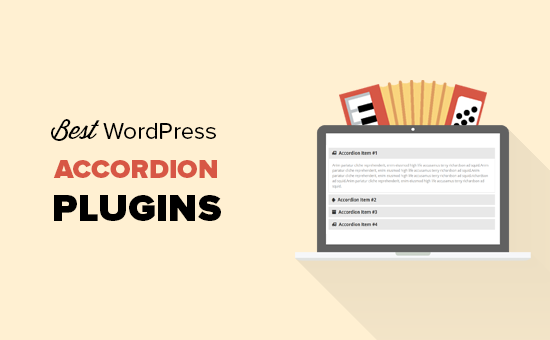
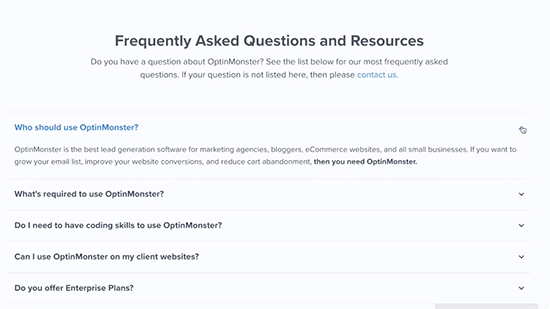
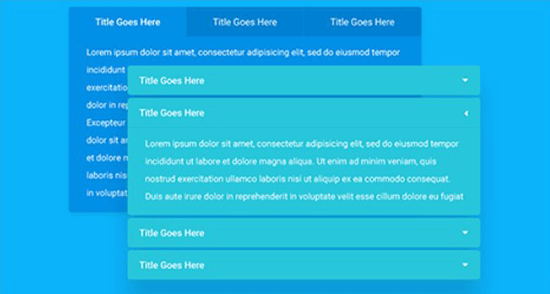
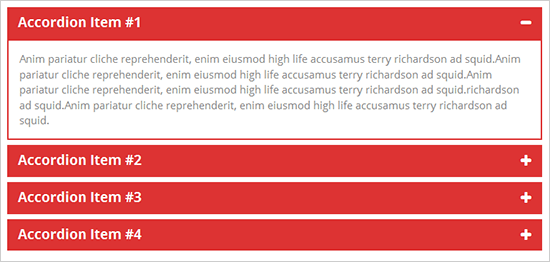
Are you looking for the best accordion plugins? An accordion is a neat web design technique which allows you to display content in collapsible tabs. In this article, we have hand-picked the 7 best WordPress accordion plugins that you can use on your website.
Why Do You Need to Add Accordions in WordPress?
Accordions allow you to display more content on your posts and pages without adding long scrolls. If you want to shrink the length of a page, then you should consider adding your content in an accordion element.
You can add vertical or horizontal accordions with the text inside each tab. When users click or mouseover on the tab, it expands to reveal the content.
Accordions are most commonly used to add a frequently asked questions (FAQs) section, by displaying questions as tabs. However, you can use them to add any kind of content where you want to save users from scrolling.
That being said, let’s take a look at some of the best WordPress accordion plugins that you can use on your WordPress website.
Accordion is a handy WordPress plugin which allows you to add beautiful accordions in your pages, posts, template files, and anywhere on your site using shortcodes. It has a responsive design and displays your content beautifully on all devices. Accordion has Font Awesome icon font support which allows you to use beautiful icons to your accordion tabs.
You can add unlimited accordions on your site using this plugin. It allows you to change styles for the opened and closed accordion, hide the accordion without deleting, text alignment for content, and more.
Accordion FAQ is another accordion plugin for WordPress sites. It has a drag and drop builder that helps you easily add accordions anywhere on your WordPress blog. You can sort the accordions and manage their placement by dragging them up or down in the backend.
It has multiple templates, unlimited color options, Font Awesome icons support, bootstrap framework for responsive design, and more. Accordion FAQ loads faster which is great for search engine rankings of your site.
Tab, Accordion and FAQ is a WordPress plugin that allows you to add beautiful animated tabs and accordions in WordPress. You can easily add responsive horizontal, vertical, animated, and other accordions to WordPress posts, pages, and sidebar widget areas.
It has multiple transition effects, different layouts, drag and drop functionality for sorting tabs, and more.
Arconix Shortcodes is a multipurpose WordPress plugin based on different style shortcodes to add tabs and accordions on your site. It displays your content in accordions and appears neatly on all mobile devices.
You can create unlimited accordions and add them anywhere with the help of shortcodes. The plugin also comes with a compatibility mode which allows you to prevent shortcode name conflicts.
Easy Accordion is another WordPress accordion plugin that allows you to set up unlimited accordions and add them on your pages, posts, widget areas, and template files.
If you buy their premium version, then it comes with additional features like advanced shortcode system, accordions from WordPress categories and custom taxonomies, themes, unlimited colors support, and more.
Shortcodes Ultimate is a comprehensive WordPress plugin that comes with a set of shortcodes to add multiple features. You can use this plugin to add accordions on your site with its 1-click shortcode insertion and live preview.
It has a custom widget that you can use to add the accordion in any widget area of your WordPress site. Shortcodes Ultimate is easy to use and functions smoothly with modern WordPress themes.
Smooth Accordion is a simple WordPress accordion plugin. Like other accordion plugins, it allows you to add accordions on your pages and posts. Smooth Accordion adds an icon in your WordPress post editor that helps in adding the accordions in your posts and pages right away.
You can customize the background color, add custom styles to accordions, and align your content easily in plugin settings.
We hope this article helped you find the best WordPress accordion plugins. You may also want to see our ultimate step by step WordPress speed and performance guide for beginners.
If you liked this article, then please subscribe to our YouTube Channel for WordPress video tutorials. You can also find us on Twitter and Facebook.
Ever wished that you could edit and write WordPress posts from the front end of your site? If so, you’re in luck because WordPress front end editor plugins can make that dream a reality. With them, you, and potentially other users at your site, can edit posts without ever needing to look at the back ... Read more5 Best WordPress Front End Editor Plugins For Easy Content Creation